 Curve
Curve
Curve pool withdrawals return one coin or a proportional share of pool assets
Curve pool withdrawals redeem liquidity provider (LP) tokens for one selected coin or a proportional share of the pool’s assets. A proportional exit follows current pool balances. A single-coin exit concentrates the payout in one asset and uses the pool’s pricing and fee calculation. Staked LP tokens must first become available for redemption.
· last updated
The important choice is the token mix you want to hold after leaving the pool. Your original deposit does not fix that mix. Compare the actual withdrawal quote, the minimum amounts, and the asset form each route returns.
Current Balances Set the Withdrawal Mix
Pool balances determine the composition of a proportional withdrawal, even when the assets originally targeted equal values. Trades change those balances after a deposit. A balanced exit therefore means withdrawing in the pool’s existing proportions; it does not promise equal token quantities or equal market values. Your LP tokens represent a share of the pool as it stands when redemption executes. Each coin amount follows that share, subject to the implementation’s balance accounting and integer rounding.
A coin trading below its intended peg can still form part of that payout. Removing liquidity transfers the current pool share; it does not promise the deposit’s original value.
LP Tokens in Your Wallet or Gauge
Wallet-held LP tokens can support a direct pool withdrawal, while tokens staked in a gauge remain in that staking contract. Unstaking returns LP tokens; redeeming those tokens removes liquidity from the trading pool. Confirm the pool, network, and LP token address before interpreting an apparently empty wallet balance. A gauge balance and a wallet LP balance describe different locations for the same pool exposure. If another contract holds the position, its withdrawal mechanism determines how the pool tokens become available.
Proportional Redemption and Pool Charges
Direct proportional redemption burns the chosen LP amount and calculates each coin payout from the same ownership fraction. The pool’s liquidity balances retain their relative proportions apart from rounding.
Reserve Share Calculation
The unrounded reserve-share calculation is coin amount = pool-accounted coin balance × LP tokens burned ÷ total LP supply before burning. Each coin has its own balance and token precision. Integer division can leave small rounding differences. Use the balances the contract treats as liquidity, which may exclude accrued admin fees.
Charges Around the Redemption
Pool-Level Fees
Twocrypto-NG does not charge a pool fee for direct proportional liquidity removal. Single-coin conversion, a helper’s additional operations, and subsequent swaps have separate cost mechanics.
Network Execution Costs
Network execution still costs gas when the pool charges no withdrawal fee. The total also reflects any unstaking or approval transactions the chosen path needs.
Why Does a Single-Coin Withdrawal Quote Change?
A single-coin quote changes because pool balances, the LP amount, pricing parameters, and applicable fees shape the selected coin’s output. The pool calculates an exit for one coin and burns the specified LP amount. This concentrates the withdrawal’s effect in that asset, changing the balance ratio. The calculation cannot simply add proportional token amounts: different coins have different units and values. Use the selected coin’s redemption quote for the same LP amount when comparing exit modes.
StableSwap-NG applies dynamic fees to single-coin removal through its imbalance-sensitive calculation. CryptoSwap implementations use their own pricing and fee logic. A larger exit can change the effective rate, so multiplying a small withdrawal quote can misstate a larger payout. A pool’s displayed base fee also does not necessarily describe the effective charge for a particular withdrawal.
How Does Minimum Output Protect a Withdrawal?
Minimum-output checks make execution fail when the calculated coin output falls below an enforced limit. A single-coin call uses a minimum for its chosen coin. A proportional call uses minimum amounts for the coins it returns. Twocrypto-NG v2.1.0 skips proportional minimum checks when the burn equals the entire LP supply. StableSwap-NG checks the calculated transfer amount, so a token’s transfer fee can reduce what the recipient receives. A preview only estimates what the pool would return at the quoted state.
A StableSwap-NG single-coin withdrawal reverts if its calculated output falls below the specified minimum. Other transactions can change pool state between preview and execution. Lowering the limit permits a worse outcome. Setting it at the exact quote can make ordinary state changes or rounding enough to prevent execution.
A zero minimum removes the output floor for that parameter. It does not correct a stale quote, an incorrect coin index, or an unsuitable withdrawal route. Contract minimums use raw token units, so integrations must apply the output token’s decimal precision.
A Larger Proportional Exit Changes Both Outputs
A larger proportional withdrawal increases both coin outputs and leaves fewer LP tokens. Consider a hypothetical two-coin pool supporting direct proportional redemption, with 6,850 LP tokens outstanding. Its withdrawable balances contain 34,250 units of the first coin and 20,550 units of the second. Compare alternative burns of 137 and 187 LP tokens; all these inputs are illustrative.
The arithmetic assumes unchanged accounted balances and LP supply at execution, ordinary token transfers, and no intermediate pool activity. The wallet holds enough LP tokens for either option. The withdrawal limits must also permit the calculated amounts. Changing the burn amount before signing does not itself alter the pool.
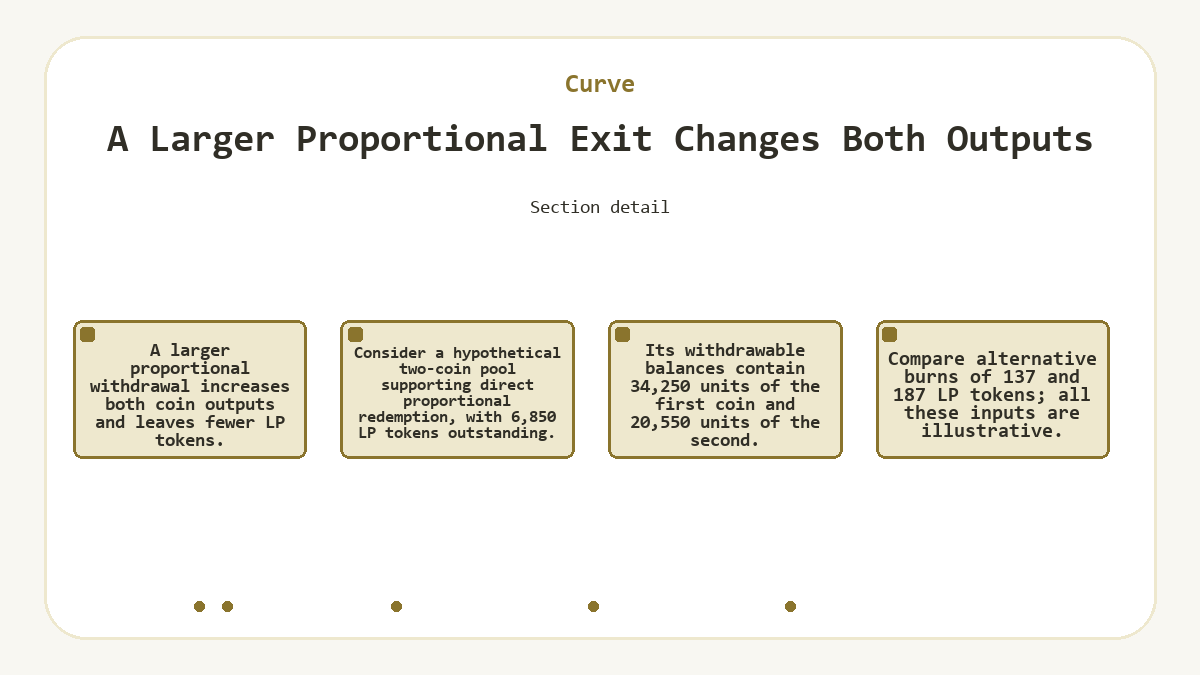
Choosing 137 LP tokens redeems 137 ÷ 6,850 = 2% of each balance: 685 units of the first coin and 411 units of the second. Choosing 187 LP tokens instead returns 935 and 561 units, respectively. The larger burn adds 250 first-coin units and 150 second-coin units, while consuming 50 more LP tokens.
The proportional method cannot increase only the first-coin payout. A single-coin exit needs a separate quote using the pool’s pricing calculation. After a successful proportional withdrawal, reconcile the chosen burn with the LP balance decrease and each coin’s incoming transfer. A completed redemption changes the position; redepositing is a new liquidity operation with its own conditions.
Custom Amounts and Metapool Asset Forms
Some pool implementations let you specify desired coin amounts, while metapool routes can also change the form of the assets received.
Requested Amounts and Maximum LP Burn
StableSwap-NG plain pools support custom withdrawals through
remove_liquidity_imbalance. The caller supplies requested coin amounts and an upper limit on LP tokens to burn. The pool computes the required burn, accounts for applicable fees, and rejects a burn above that limit. This mode can match a chosen token mix without fixing the LP amount in advance. Custom withdrawal support follows the specific pool implementation.
Base Pool Shares and Underlying Coins
A StableSwap-NG metapool pairs a coin with another pool’s LP token. Direct redemption can therefore return a base pool LP token as part of the payout. Where a compatible withdrawal zap exists, that helper can redeem the base pool share into its constituent coins. Direct and helper withdrawals can produce different token forms. The quote and output limits must refer to the final tokens the selected route sends.
One-Coin Redemption or a Separate Swap
A direct single-coin redemption and a proportional withdrawal followed by swaps use different fee and pricing calculations. The second approach combines reserve-share withdrawal with separate token exchanges. Converting unwanted coins adds their exchange costs and price impact. Those conversions also encounter the pool states present when each exchange executes. Neither approach guarantees the larger payout across every pool or withdrawal size.
A routed operation may bundle multiple contract calls into one transaction. Conceptual steps alone do not establish the number of wallet confirmations. Compare final token quantities and execution costs for the actual route.
What Confirms a Completed Pool Withdrawal?
A completed pool withdrawal has successful onchain execution, an LP token burn, and outgoing coin transfers to the intended recipient. A submitted transaction hash alone does not establish those outcomes.
Proportional exits emit a removal event with withdrawn token amounts. Single-coin exits record the LP burn and selected coin output in their corresponding event. Match those records to the receiver’s token balances, allowing for other activity affecting the same balances. When a helper handles redemption, its final coin transfers identify the assets reaching the recipient.
Any remaining LP balance continues to represent pool exposure, even if an interface reports a partial withdrawal as successful. The redeemed portion leaves that exposure in exchange for the delivered assets.
Still wondering about Curve?
Does Approving an LP Token Transfer Complete a Withdrawal?
An LP token approval authorizes spending and does not itself redeem pool liquidity. It changes the permitted spender’s allowance. A helper may need that allowance before it can take LP tokens for redemption. Withdrawal completion requires the separate redemption operation and its coin transfers.
Can I Direct My Curve Withdrawal to Another Address?
StableSwap-NG and Twocrypto-NG withdrawal methods support a receiver address for the redeemed coins. Their receiver defaults to the caller when omitted. A particular interface or helper may expose a different set of options, so its actual transaction determines the recipient. Directing the payout elsewhere also means the coins will not appear in the LP owner’s wallet balance.
What Happens to My LP Tokens If the Withdrawal Transaction Reverts?
A fully reverted pool withdrawal does not retain its LP burn or coin transfers. An earlier successful unstaking transaction remains effective if it occurred separately, leaving the unstaked LP tokens outside the gauge. A transaction included onchain can still consume gas when execution fails; a rejection before submission has no executed withdrawal to reverse.
Why Can Proportional Withdrawal Work When a single-coin Quote Fails?
Proportional withdrawal can avoid the invariant-solving calculations a single-coin exit needs. Twocrypto-NG uses a simpler balance-and-supply calculation for direct proportional removal, which can remain usable despite an AMM calculation problem. This method still enforces LP ownership, minimum amounts for burns below the pool’s total LP supply, and successful token transfers. A token-transfer failure can still block the proportional exit.
Does Withdrawing My Maximum LP Balance Empty the Pool?
Redeeming your full LP balance does not empty the pool unless you hold its entire outstanding LP supply. Other providers’ shares remain backed by the remaining pool assets. A maximum amount for your position concerns the LP tokens available to that withdrawal path. Emptying the whole pool also requires a withdrawal method supporting the relevant full-supply case.
Is Virtual Price a Guaranteed single-coin Redemption Rate?
Virtual price does not guarantee the amount a single-coin withdrawal will deliver. In classic StableSwap pools, it measures the pool invariant per LP token, using the contract’s precision scaling. A selected-coin withdrawal uses its own calculation and applicable fees. The virtual price alone therefore cannot supply the output amount or minimum for that redemption.